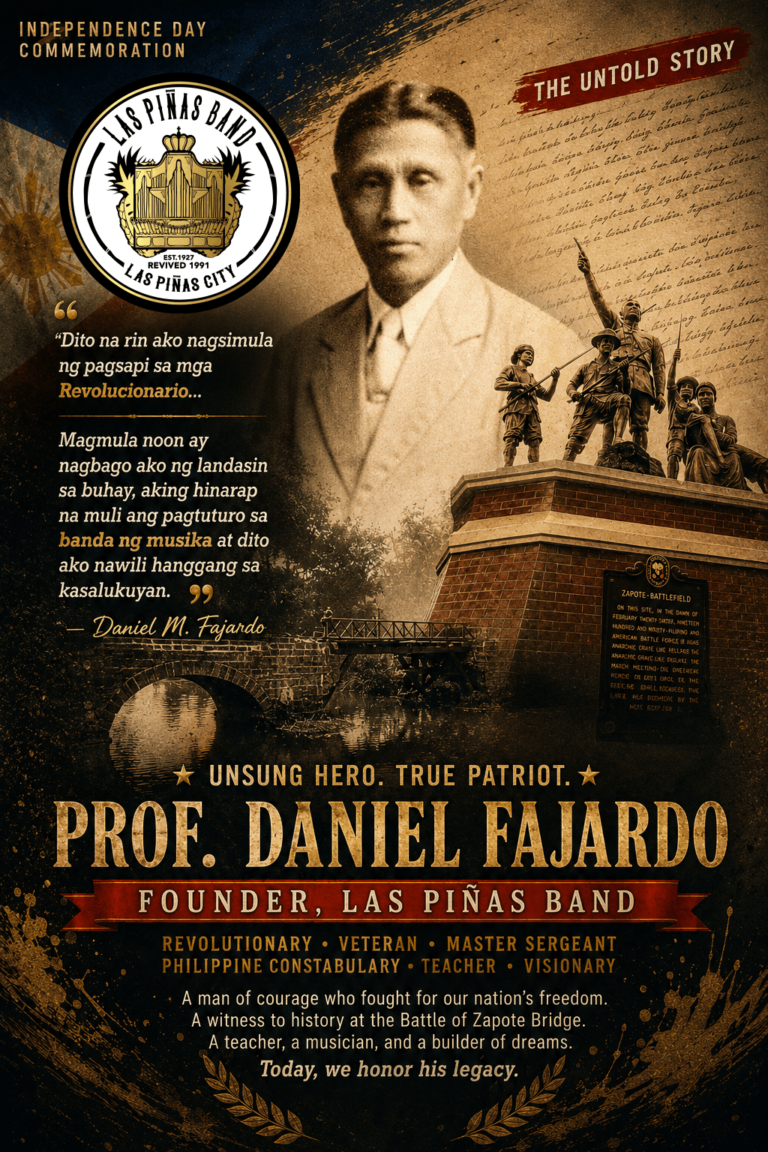
A Forgotten Chapter in Philippine History
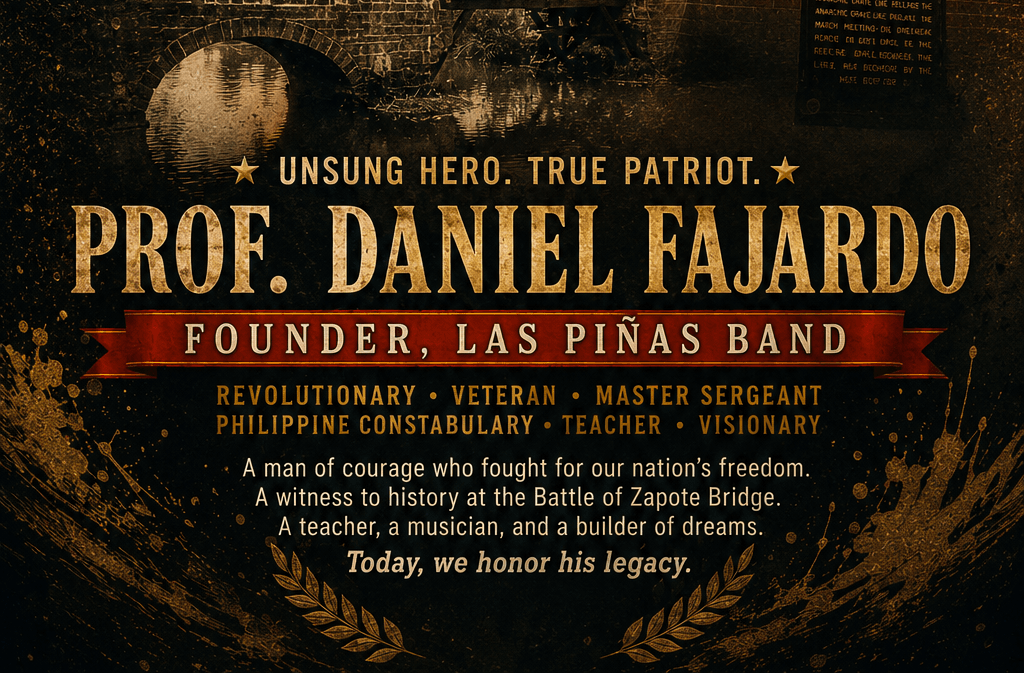
For more than a century, Prof. Daniel M. Fajardo has been remembered as a musician, educator, composer, and founder of the historic Banda de Las Piñas. Established in 1927, the band became one of the most enduring musical institutions in Las Piñas and an important part of Philippine band history.
Yet hidden among old family records was a story that had never been shared publicly, never been published, and never been passed down through the generations.
In 2018, Liz Fajardo discovered a handwritten manuscript among old family records preserved by Daniel Fajardo’s descendants. The document revealed a previously unknown chapter of his life—his experiences during the Philippine Revolution and the Battle of Zapote Bridge.
Long before he became a band founder, Daniel Fajardo was a young musician who found himself in the middle of one of the most turbulent periods in Philippine history. His account describes revolutionary activities across Cavite, his participation in the revolutionary movement, and his first-hand observations during the historic Battle of Zapote Bridge.
To the best of his family’s knowledge, this chapter of Daniel Fajardo’s life was never discussed within the family and remained absent from the historical narrative surrounding his legacy. For generations, he was remembered primarily for his contributions to music.
The rediscovery of this manuscript offers a new perspective on the life of a man who helped shape the musical identity of Las Piñas. More importantly, it provides a rare first-hand account that connects local history, the Philippine Revolution, and the enduring legacy of Banda de Las Piñas.
What follows is not merely family history.
It is the story of a musician, a revolutionary, and a founder—told in his own words.
The Discovery of a Lost Manuscript of Daniel M. Fajardo
The manuscript was discovered in 2018 among family records and historical materials preserved by the descendants of Daniel M. Fajardo.
Written in his own hand, the document recounts his experiences during the Philippine Revolution. Furthermore, it provides a rare first-person narrative from a man who would later become one of the most influential figures in Las Piñas music history.
At the time, Daniel Fajardo was a young musician from Las Piñas. What began as a trip to Tanza, Cavite to prepare a band for a local fiesta soon placed him in the middle of a defining period in Philippine history.
Daniel M. Fajardo: A Witness to the Philippine Revolution
According to his account, revolutionary activity quickly spread throughout Cavite following the outbreak of the Revolution in 1896.
Daniel Fajardo described seeing revolutionary forces move through Imus, Kawit, Noveleta, Tanza, Naic, Maragondon, and neighboring towns. He witnessed captured Guardia Civil soldiers join the revolutionary cause. Eventually, he became involved himself.
In his own words:
“Dito na rin ako nagsimula ng pagsapi sa mga Revolucionario.”
His manuscript also contains a rare first-hand account of the fighting at the historic Battle of Zapote Bridge. In fact, the battle was one of the most important engagements of the Philippine Revolution.
Daniel M. Fajardo’s Manuscript
The following is presented exactly as written by Daniel M. Fajardo. For historical accuracy, the original wording and spelling have been preserved.
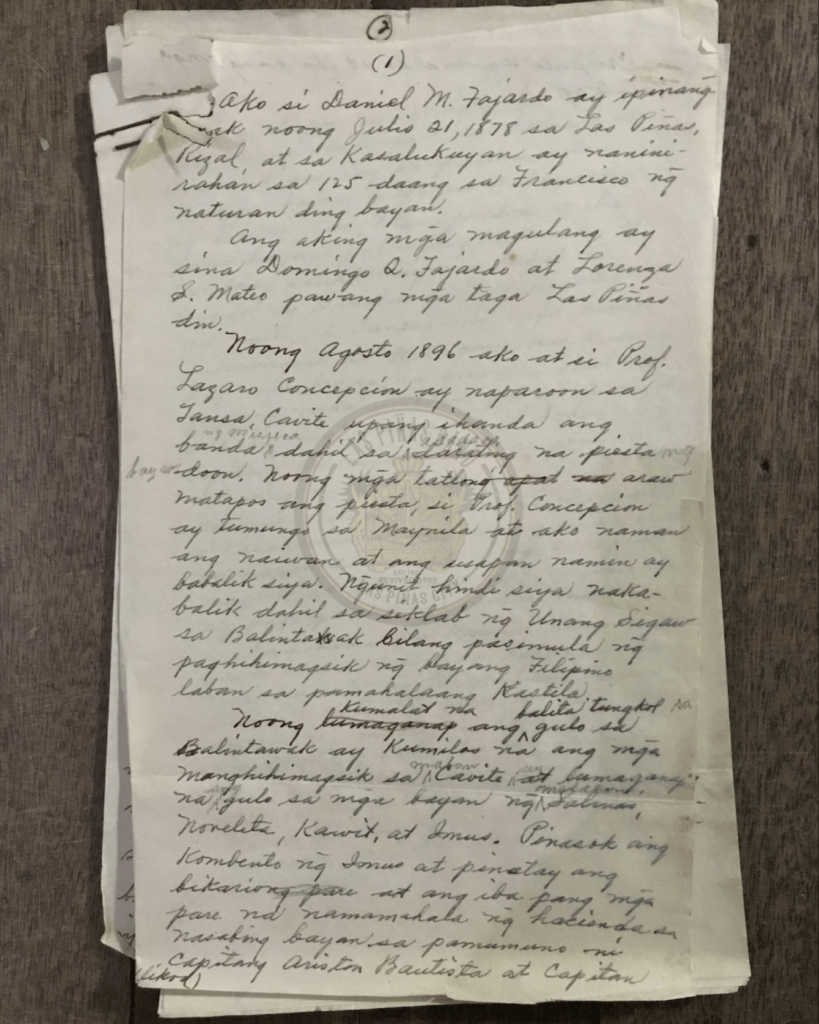
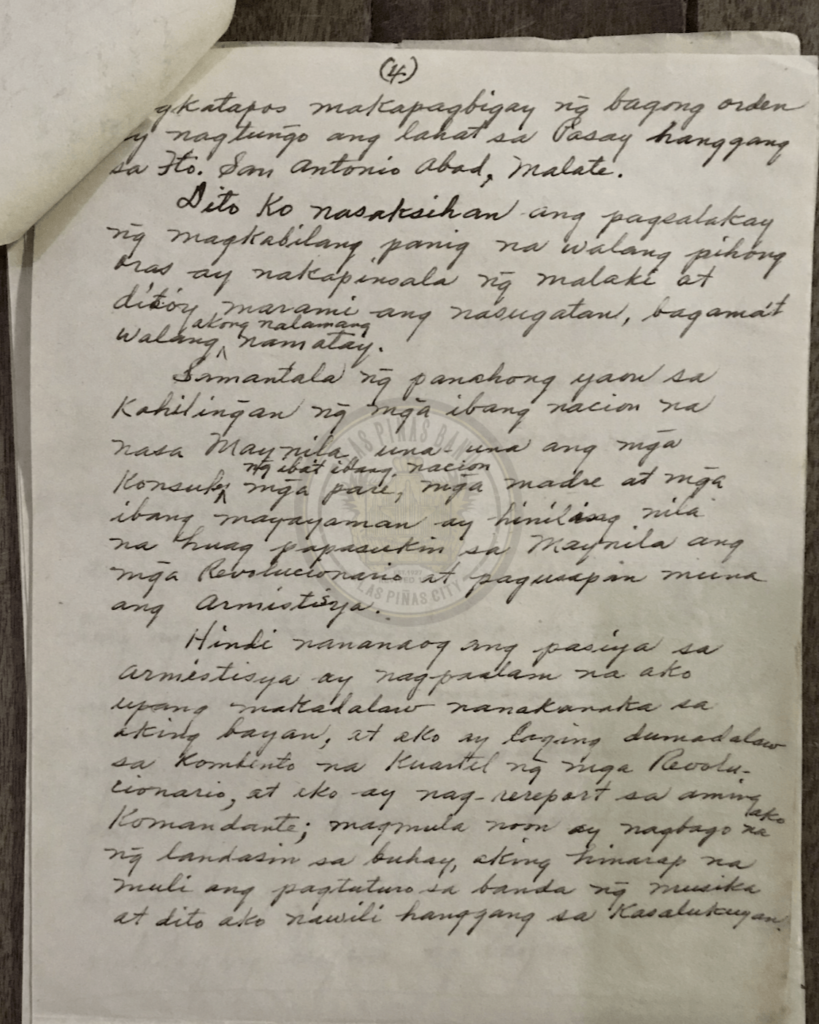
“Ako si Daniel M. Fajardo ay ipinanganak noong Julio 21, 1878 sa Las Pinas, Rizal, at sa kasalukuyan ay naninirahan sa 125 Daang San Francisco ng naturang bayan.
Ang aking mga magulang ay sina Domingo Q. Fajardo at Lorenza S. Mateo pawing mga taga Las Pinas din.
Noong Agosto 1896 ako at si Prof. Lazaro Concepcion ay naparoon sa Tanza Cavite, upang ihanda ang banda dahil sa darating na piesta doon. Noong mga tatlong araw matapos ang piesta, si Prof. Concepcion ay tumungo sa Maynila at ako naman ang naiwan, at ang usapan namin ay babalik siya. Ngunit hindi siya nakabalik dahil sa siklab ng Unang Sigaw sa Balintawak bilang pasimula ng paghihimagsik ng bayang Filipino laban sa pamahalaang Kastila.
Noong kumalat na ang balita tungkol sa Balintawak ay kumilos na ang gulo sa mga naghihimagsik sa Mabon Cavite, at lumaganap na ang gulo sa mga bayan ng Salinas, Noveleta, Kawit, at Imus.
Pinasok ang kombento ng Imus at pinatay ang bikario at ang iba pang mga pare na namamahala ng hacienda sa nasabing bayan sa pamumuno ni Capitan Ariston Bautista at Capitan Crispulo Aguinaldo at iba pang mga katulong.
Pagkatapos nito nagtungo ang mga nanghihimagsik sa Salinas, at tumawid sa ilog sa pamamagitan ng mga balsa, tuloy sa kabayanan ng Tanza, Naic, Maragondon at iba pang bayan patungong kaitaasan at kanilang sinalakay ang lahat ng Kuartel ng Guardia civil.
Bumalik na muli ng Tanza ang mga manghihimagsik na kasama ang mga bihag na guardia civil na pawang naka uniforme pa at tumigil sila sa malaking solar at bahay ni Capitan Adriano Soriano at ginawa dito ang malaking pagsasaya at kainan. Dito sila nagkaroon ng pacto o kasunduan at ang mga guardia civil ay nakisama na sa mga manghihimagsik, at dito na rin ako nagsimula ng pagsapi sa mga Revolucionario.
Samasama na kaming tumungo sa Bacoor at pagdating sa sabungan doon kami kumain ng tanghalian. Pagkatapos tumuloy kami sa tulay ng Zapote at dito nagkaroon ng madugong labanan. Ang pangkat ng kaballeria at infanteria ng mga kastila ay nasa gawing Las Pinas, at ang mga Revolucionario ay nasa gawing Bacoor at Pamplona. Dito laging nagkakaroon ng labanan, sa umaga, tanghali at gabi.
Dahil sa kagustuhan kong makita ang aking mga magulang, ay humingi ako ng pahintulot sa isang mataas na pinuno at dahil dito’y nakauwi ako ng lihim sa Las Pinas.
Sa Pangamba ng aking ama na ako’y hulihin pa, ay iniharap ako sa Juez de Paz na si Apolinario Acosta (isang mestisong kastila) at iniharap naman ako sa Cuartel ng guardia civil, at dito’y siniyasat ako ng isang Capitan. Tinanong ako sa mga bagay na nasaksihan ko at ng mga bagay tungkol sa aking pagkatao. Hinubaran ako ng damit sa buong katawan upang makakita ng mga palatandaan na makagpagpapatotoo na akoy kaanib nga sa mga Revolucionario.
Nasiyahan ang Capitan sa mga kasagutan ko at ang parusa sa akin ay magpresinta ako sa cuartel araw araw, ngunit hindi nangyari ang gayon sapagkat labing pitong araw lamang ang nakaraan ay gumawa na ng malaking pagsalakay ang mga Revolucionario, na hinati sa tatlong pangkat ang isa ay sa baybay dagat, ang pangalawa ay sa pangulong daan, at ang ika tatlo ay sa baybay bukid, at sa ganitong paraan ay nabigla ang infanteria, caballeria, at guardia civil at nagsiurong na sila sa Maynila.
Samantala naman ang mga Revolucionario ay tumigil sa kombento ng Las Pinas hanggang tanghali, at pagkatapos ay nagtungo ang lahat sa Pasay hanggang sa Sto. San Antonio Abad, Malate.
Dito ko nasaksihan ang pagsalakay ng magkabilang panig na walang piling oras ay nakapinsala ng malaki at dito’y marami ang nasugatan, bagama’t wala akong nalamang namatay.
Samantala ng panahong yan sa kahilingan ng mga ibang nacion na nasa Maynila, una una ang mga Konsul ng ibat ibang nacion, mga pare, at mga ibang mayayaman ay hiniling nila na huwag papasukin sa Maynila ang mga Revolucionario at pagusapan muna ang armistisya.
Hindi nananaog ang pasiya sa armistisya ay nagpaalam na ako upang makadalaw manakanaka sa aking bayan, at ako ay laging dumadalaw sa kombento ng kuartel ng mga Revolucionario, at ako ay nag rereport sa aming Komandante; magmula noon ay nagbago ako ng landasin sa buhay, aking hinarap na muli ang pagtuturo sa banda ng musika at dito ako nawili hanggang sa kasalukuyan.”
— Daniel M. Fajardo
The Battle of Zapote Bridge Through the Eyes of Daniel Fajardo
Among the most significant portions of the manuscript is Daniel Fajardo’s description of the fighting at Zapote Bridge.
Located between present-day Las Piñas and Bacoor, Zapote Bridge became a strategic battleground during the Revolution. There, Daniel recalled how Spanish infantry and cavalry occupied the Las Piñas side while revolutionary forces held positions in Bacoor and Pamplona.
His account provides a rare local perspective from someone who witnessed the events firsthand.
This manuscript serves as an important historical document connecting Las Piñas with local history and the broader story of Philippine independence.
A Revolutionary’s Journey Ends in Music
Daniel Fajardo’s account provides a rare glimpse into one of the most turbulent periods in Philippine history.
As a young musician, he found himself caught in the unfolding events of the Revolution. He witnessed revolutionary movements across Cavite, joined the revolutionary cause, saw the fighting at Zapote Bridge, endured interrogation by Spanish authorities, and observed the struggle for independence from a perspective few could ever recount.
Yet perhaps the most remarkable part of his story is not that he became a revolutionary.
It is that after witnessing war, he chose music.
In the final lines of his manuscript, he wrote:
“Magmula noon ay nagbago ako ng landasin sa buhay, aking hinarap na muli ang pagtuturo sa banda ng musika at dito ako nawili hanggang sa kasalukuyan.”
The revolutionary became a teacher.
The witness to war became a mentor.
The young musician who witnessed the birth of a nation would later establish one of Las Piñas’ most enduring musical institutions.
The Birth of Banda de Las Piñas
Three decades after the Revolution, Daniel Fajardo founded the Banda de Las Piñas in 1927.
Under Daniel Fajardo’s leadership, Banda de Las Piñas became one of the most respected and accomplished musical organizations in Las Piñas.
Under Daniel Fajardo’s leadership, Banda de Las Piñas or Las Piñas Band became the most decorated marching band in Las Piñas.
The band earned recognition through numerous prestigious competitions, including the Philippine Carnival National Band Contest, one of the country’s most prominent musical competitions during its time. The Philippine Carnival, also known as Manila Carnival showcased a band competition featuring 37 distinguished bands from across the Philippines.
In February 1929, Banda de Las Piñas won 4th Place for its performance of Il Guarany and received a Buescher cornet as its prize. The following year, in February 1930, the band achieved 1st Place for its performance of Mignon and was awarded a Golden Sousaphone (Bajong Ginto). In February 1931, the band secured 2nd Place for its rendition of Second Hungarian Rhapsody and received the Silver Cup.
Daniel Fajardo’s influence extended beyond Banda de Las Piñas. In February 1941, he organized a combined band composed of approximately 50 musicians from Banda de Las Piñas, Banda Kabataan, and the Manuyo Band, where he also served as conductor. The ensemble competed in the National Band Championships and won the Second Silver Cup.
These achievements reflected not only the musical excellence of the band but also the discipline, dedication, and countless hours of rehearsal invested by its members. Through active participation in concerts, civic celebrations, religious festivities, and competitions, Banda de Las Piñas established itself as a leading musical institution in the region.
By the time of Daniel Fajardo’s passing in 1959, the band had earned a reputation for excellence, discipline, and service to the community. Over time, it became a lasting symbol of Las Piñas’ rich musical heritage and an enduring part of Philippine band history.
Generations of musicians would pass through the band, preserving traditions of discipline, excellence, and public service through music.
Today, that legacy continues through Las Piñas Band ’91. The organization remains committed to preserving the heritage, history, and musical traditions established by its founder.
Veteranos de la Revolucion: Music as Remembrance
Daniel Fajardo’s experiences during the Philippine Revolution shed new light on one of his most enduring compositions, Veteranos de la Revolucion. As a result, the work takes on a deeper historical meaning.
Viewed through the lens of his newly discovered manuscript, the composition takes on a much deeper meaning.
This was not merely a musical work.
It was remembrance.
A tribute to the generation that fought for freedom.
A piece of history preserved not through words alone, but through music.
The title itself, Veteranos de la Revolucion (“Veterans of the Revolution”), reflects a deep respect for those who fought for Philippine independence.
For Daniel Fajardo, the Revolution was not an abstract chapter in a history book.
It was something he saw.
Something he lived.
Something he remembered.
And through music, it became something he passed on to future generations.
Watch Las Piñas Band perform Veteranos de la Revolucion:
More Than History. The Living Legacy of Daniel M. Fajardo
The discovery of Daniel Fajardo’s manuscript revealed a forgotten chapter in the story of the founder of Banda de Las Piñas.
It showed that behind the conductor, composer, educator, and band founder stood a man who witnessed the birth of a nation.
His story reminds us that history is not preserved only in monuments and official records.
Sometimes it survives in handwritten pages tucked away for generations.
Sometimes it survives through music.
And sometimes it survives through the institutions built by those who lived through history themselves.
Today, every performance by Las Piñas Band ’91 carries forward a tradition established by Daniel M. Fajardo—a revolutionary, teacher, musician, and founder whose life bridged two defining chapters of Philippine history:
The struggle for freedom.
And the enduring power of music.